6 posts tagged with "partnerships"

View All Tags

Blockscout introduces contract identity scoring via Enscribe

· 4 min read
Conor Svensson
Founder of Enscribe and Web3 Labs

Blockscout introduces contract identity scoring via Enscribe

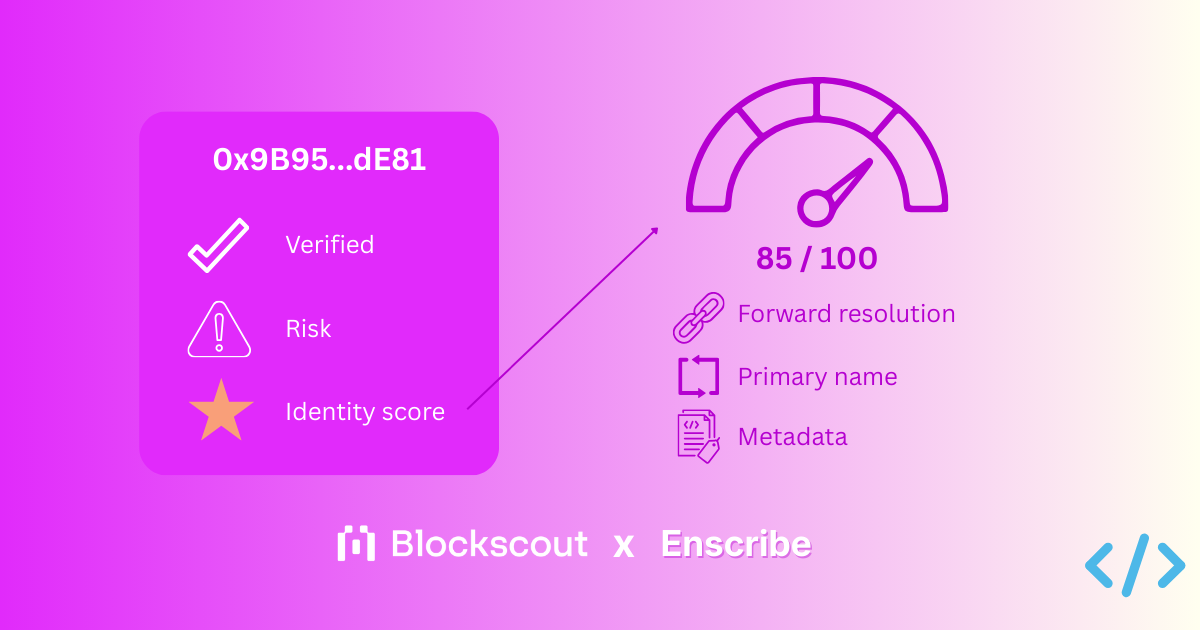
Blockscout smart contract pages now include an Identity score powered by Enscribe.

Blockscout is a leading open-source blockchain explorer for viewing transactions, smart contracts, and onchain activity across hundreds of networks.

The score provides a structured way to measure how clearly a contract is identified onchain with ENS. It is calculated by the Enscribe smart contract scoring API and displayed directly within Blockscout’s contract interface.

Blockscout contract view

Contract identity now sits next to verification and risk details on Blockscout contract pages.

What the identity score represents

The identity score ranges from 0 to 100. It reflects how well a contract’s ENS configuration establishes a clear, canonical onchain identity.

Enscribe identity score

The score is derived from three measurable signals:

  • Forward resolution count — how many ENS names resolve to the contract address
  • Primary name (reverse resolution) — whether the contract resolves back to a canonical ENS name
  • Metadata text records — whether descriptive ENS text records are set

Each tier reflects a progressively stronger configuration, where a zero score means no identity information is set for the contract, through to 100 where a primary name is set as well as relevant metadata.

Multiple forward records lower the score because it creates ambiguity as to its true identity.

How the integration works

Blockscout retrieves identity data from the Enscribe API. When queried, the API:

  1. Checks ENS forward resolution and reverse resolution for the address
  2. Reads ENS metadata text records
  3. Calculates a score according to the tier model

Responses are short-lived cached. This supports stable and fast explorer lookups while allowing changes to propagate as ENS records are updated.

The scoring logic is deterministic and based entirely on publicly verifiable ENS state.

Identity versus verification

For some time, it's been considered a best practice for developers to verify their smart contracts, but this isn't the same as having a concrete identity.

Source code verification confirms that deployed bytecode matches published source, whereas identity scoring demonstrates if a contract is clearly and consistently identified onchain.

A contract may be verified but still lack:

  • A canonical ENS name
  • A primary name
  • Descriptive metadata

Without those elements, users must rely on raw addresses or external documentation to interpret what they are interacting with.

The identity score addresses that gap directly within the explorer interface. Users can then click on the identity score to view the contract in Enscribe to see all of the identity information associated with the smart contract.

Enscribe contract view

Why this matters for explorers

Blockscout aggregates multiple signals to help users understand contracts. Identity scoring complements those signals without overlapping them.

It does not measure security, risk, or audit status. It measures identification which is vital for enhancing user trust.

By making ENS configuration visible as a score, Blockscout:

  • Encourages consistent naming practices
  • Makes identity gaps observable
  • Provides a simple benchmark for improvement

Because the score is numeric and tiered, it can be compared across contracts in a consistent way.

Improving your score

Contracts reach the highest identity score by configuring:

  • One forward-resolving ENS name
  • A primary name (reverse resolution)
  • Complete ENS metadata text records

These signals are entirely onchain and publicly verifiable, and can easily be managed in the Enscribe App.

Teams can update ENS configuration at any time, and the score will reflect those changes.

Try it

The identity score is now live on Blockscout.

View a contract page to see how identity is measured, or use Enscribe to configure ENS names and metadata for your own contracts.

Happy naming! 🚀

Based Nouns introduces ENS-based naming for its smart contracts with Enscribe

· 3 min read
Conor Svensson
Founder of Enscribe and Web3 Labs

Based Nouns x Enscribe logos

Based Nouns has adopted ENS-based naming across its smart contract infrastructure, using Enscribe to assign clear, human-readable identities to the contracts that power the DAO.

As a Nouns Builder–based DAO deployed on Base, Based Nouns operates with a faster iteration cycle and a more experimental governance environment than mainnet Nouns. Clear contract naming helps ensure that this agility does not come at the cost of safety.

A different kind of Nouns DAO

Based Nouns is not a fork of Nouns DAO — it’s an independent DAO built using the Nouns Builder framework and deployed on Base.

This means:

  • a modular contract architecture
  • more frequent experimentation and upgrades
  • a broader set of contributors interacting directly with the protocol

In this environment, relying on raw contract addresses quickly becomes a bottleneck for understanding, reviewing, and integrating DAO infrastructure.

ENS-based naming makes contract intent explicit.

How naming helps Based Nouns

Using Enscribe, Based Nouns has assigned structured ENS names to its core contracts, reflecting their roles within the DAO’s governance, auction, and treasury systems.

Based Nouns smart contracts

View Based Nouns contracts in the Enscribe App

These names form a coherent onchain directory that mirrors the DAO’s architecture. ENS reverse resolution cryptographically links each name to its deployed address, allowing wallets, explorers, and dashboards to surface trusted identities automatically.

This is particularly valuable for DAOs like Based Nouns, where contributors, builders, and delegates may be onboarding continuously.

Benefits for the Based Nouns ecosystem

Faster governance review

Delegates can more easily understand which contracts are referenced in proposals and upgrades.

Safer tooling and integrations

Builders working with Based Nouns can integrate against named contracts rather than manually tracking addresses.

Lower cognitive overhead

Community members and researchers can reason about the DAO’s infrastructure without needing deep address-level context.

Future-proofing experimentation

As the DAO evolves, naming helps preserve clarity even as contracts change.

Enscribe’s role

Enscribe provides the infrastructure that enables DAOs to manage structured, verifiable ENS names for smart contracts.

For Based Nouns, this ensures that contract identities remain consistent, resolvable, and compatible across ENS-enabled tooling, regardless of deployment cadence or network.

Naming for the next generation of DAOs

ENS-based contract naming is not just for long-lived mainnet protocols. It is equally important for newer, faster-moving DAOs building on L2s.

Based Nouns’ adoption reflects a growing norm: if a contract matters, it should have a name that clearly communicates what it does.

Name your contracts. Strengthen your protocol

Naming isn’t just for Based Nouns, it’s for anyone building on Ethereum.

Whether you’re a DAO, social app, game, or DeFi protocol with dozens of contracts, Enscribe helps you structure and create trust for your users.

Join the growing standard for Ethereum: Name your contracts with Enscribe.

Happy naming! 🚀

Giveth introduces ENS-based naming for core smart contracts with Enscribe

· 3 min read
Conor Svensson
Founder of Enscribe and Web3 Labs

Giveth x Enscribe logos

Giveth has adopted ENS-based naming across its core smart contract infrastructure, bringing clear, human-readable identities to the contracts that power the Giveth ecosystem.

This update makes it easier for donors, builders, researchers, and ecosystem partners to understand and verify how Giveth works onchain — without changing how the protocol itself operates.

Why contract naming matters for Giveth

Giveth exists to support public goods, community funding, and transparent coordination. Trust and transparency are foundational to that mission.

However, raw contract addresses are difficult to interpret, especially for:

  • donors who want confidence in where funds are flowing
  • contributors and integrators building tools around Giveth
  • researchers and community members analysing impact and governance

ENS-based naming helps bridge this gap by making contract roles explicit and verifiable.

Clear, structured naming across the protocol

Giveth’s smart contracts are now organised under a structured ENS namespace, with each contract receiving a name that reflects its purpose within the system.

Giveth contracts

These names form a clear, browsable onchain directory of Giveth’s infrastructure. This makes it easier to understand what powers donations, project funding, governance, and supporting infrastructure across the Giveth ecosystem.

What this improves

Transparency for donors

Human-readable contract names make it easier to verify that donations and interactions are going to the intended components of the protocol.

Safer integrations

Builders and partners can integrate against named contracts, reducing the risk of address-level mistakes.

Easier research and accountability

Clear naming improves long-term traceability of how Giveth’s onchain infrastructure evolves over time.

Accessibility

Lowering the cognitive barrier to understanding smart contracts helps make Giveth more approachable to a broader audience.

Enscribe’s role

This rollout is supported by Enscribe, which provides the infrastructure for creating and managing structured, verifiable ENS names for smart contracts.

Enscribe ensures that Giveth’s contract identities remain consistent and resolvable across ENS-enabled wallets, explorers, and developer tools.

Supporting public goods through better infrastructure

ENS-based contract naming may seem like a small change, but it meaningfully improves how onchain systems are understood, trusted, and maintained.

By making its contract infrastructure more legible and accessible, Giveth continues to lead by example in building transparent, community-oriented public goods on Ethereum.

Name your contracts. Strengthen 🦾 your protocol

Naming isn’t just for Giveth, it’s for any project building on Ethereum.

Whether you’re a funding platform like Giveth, DAO, game, or DeFi protocol with dozens of contracts, Enscribe helps you structure and create trust for your users.

Join the growing standard for Ethereum: Name your contracts with Enscribe.

Happy naming! 🚀

Cork adopts ENS-based contract naming with Enscribe

· 3 min read
Conor Svensson
Founder of Enscribe and Web3 Labs

Cork x Enscribe logos

Cork has adopted ENS-based naming across its smart contract infrastructure, using Enscribe to assign clear, verifiable identities to its core protocol contracts and wallets.

Cork is tokenized risk infrastructure: a programmable risk layer for onchain assets such as RWAs, vault tokens, and yield-bearing stablecoins.

This marks another step toward making contract naming a default expectation for production-grade DeFi protocols, not an optional enhancement, but foundational infrastructure.

From addresses to identities

Smart contracts are the backbone of onchain applications, yet they are still most commonly identified by opaque hexadecimal addresses. While precise, addresses provide no information about intent, ownership, or role within a protocol.

As protocols scale, this creates friction:

  • audits require repeated address-to-purpose mapping
  • integrations become more error-prone
  • analysts and explorers rely on off-chain labels to verify deployments

ENS-based naming replaces ambiguity with explicit, verifiable identity.

How Cork uses Enscribe

Using Enscribe, Cork has assigned structured ENS names across its contract stack. Each subsystem is given a clear namespace, and each contract is named according to its role within the protocol’s architecture.

These names are bound to deployed addresses via ENS. Wallets, explorers, and dashboards that support ENS can surface these identities automatically, without requiring any protocol changes.

The result is a coherent, browsable onchain directory that mirrors how Cork is actually built.

Cork named contracts

Why this matters beyond Cork

While this rollout directly benefits Cork’s users and contributors, it also reflects a broader shift happening across Ethereum.

More protocols are recognising that:

  • human-readable contract identities improve safety
  • structured naming reduces operational risk
  • ENS resolution is already widely supported across the ecosystem

Naming contracts is becoming part of the baseline for how serious onchain systems present themselves.

Enscribe’s role

Enscribe provides the tooling and infrastructure that makes structured contract naming practical at scale.

For Cork, Enscribe ensures that contract identities remain:

  • consistent across deployments
  • verifiable via ENS standards
  • compatible with wallets, explorers, and developer tooling

Our goal is simple: make contract naming boring, reliable, and universal.

Naming as shared infrastructure

ENS-based naming doesn’t change how protocols work — it changes how they are understood.

Cork’s adoption reinforces a growing norm: if a contract is important enough to secure value, it should have a name that clearly communicates what it does.

Name your contracts. Strengthen your protocol

Naming isn’t just for Cork, it’s for any project building on Ethereum.

Whether you’re a DAO, social app, game, or DeFi protocol with dozens of contracts, Enscribe helps you structure and create trust for your users.

Join the growing standard for Ethereum: Name your contracts with Enscribe.

Happy naming! 🚀

Liquity x Enscribe: Liquity introduces ENS-based naming for core protocol contracts

· 3 min read
Conor Svensson
Founder of Enscribe and Web3 Labs

Liquity x Enscribe logos

Liquity V2 has adopted ENS-based naming across its core smart contract infrastructure. Liquity V2 allows users to take out loans against their (staked) ETH at a fixed rate they set, in its fully decentralized stablecoin $BOLD. Liquity is one of the few projects with immutable contracts and no upgradable parameters — meaning no governance and no unpredictable changes to the protocol can be implemented.

The registration of Liquity’s immutable contracts with Enscribe introduces clear, human-readable, and verifiable identities for the contracts, replacing reliance on raw hexadecimal addresses alone.

The protocol’s mechanics remain unchanged. What improves is how those mechanics are identified, verified, and integrated across the ecosystem.

Motivation

Liquity V2 is designed around simplicity, robustness, and minimising trust assumptions. As the protocol has matured, a growing number of contracts underpin core functionality such as borrowing, stability operations, liquidations, and system coordination.

While contract addresses are precise, they do not communicate intent. This introduces avoidable friction for:

  • auditors reviewing deployments and upgrades
  • developers integrating Liquity into tooling and applications
  • researchers and users verifying onchain interactions

ENS-based naming makes contract roles explicit, without altering protocol behaviour.

Structured contract naming

Each Liquity V2 contract is now assigned a structured ENS name that reflects its function within the protocol architecture.

These names form a coherent onchain directory that mirrors Liquity’s system design. Wallets, explorers, and dashboards that support ENS resolution can display these identities, making it immediately clear which component of the protocol is being interacted with.

Names are resolved to their deployed addresses, ensuring they remain verifiable and trusted.

Liquity protocol contracts

Benefits

Auditability

Clear naming simplifies locating and viewing contracts by reducing the cognitive overhead of address mapping.

Integration safety

Developers can reference contracts by name rather than by address alone, reducing the risk of misconfiguration.

Operational transparency

Tooling and analytics can present Liquity interactions with greater precision and confidence.

User assurance

Human-readable identities make it easier to verify that interactions are occurring with the intended contracts.

Enscribe’s role

This rollout is supported the Enscribe contract naming infrastructure, which includes the Enscribe App and plugins for Foundry and Hardhat.

Enscribe ensures that Liquity’s contract identities remain consistent and resolvable across ENS-enabled wallets, explorers, and developer tooling.

Long-term maintainability

ENS-based contract naming is a small change in surface area, but an important improvement in how the protocol is understood and interacted with over time.

By making contract intent explicit, Liquity strengthens transparency, reduces operational risk, and improves long-term maintainability — without compromising the protocol’s core principles.

Name your contracts. Strengthen your protocol

Naming isn’t just for Liquity, it’s for any projects building on Ethereum.

Whether you’re a DAO, social app, game, or DeFi protocol with dozens of contracts, Enscribe helps you structure and create trust for your users.

Join the growing standard for Ethereum: Name your contracts with Enscribe.

Happy naming! 🚀

Nouns DAO x Enscribe: Bringing Clear, Human-Readable Names to the Nouns Contract Universe

· 3 min read
Conor Svensson
Founder of Enscribe and Web3 Labs

Nouns x Enscribe logos

Nouns DAO has rolled out Enscribe-powered ENS names across its contract ecosystem. This change makes the core Nouns infrastructure easier to understand, integrate with, and safer to interact with.

As Nouns has grown, so has the number of contracts powering auctions, governance, treasury movements, builder deployments, experiments, and extensions. But with growth comes complexity, and raw hex addresses don’t communicate the intent or role of a contract to users.

Naming fixes that.

By giving each Nouns contract a clear, verifiable ENS-based identity, the DAO is making its onchain footprint more accessible to builders, researchers, delegates, and collectors who want clarity with their Nouns interactions.

Why Nouns Are Doing This

🔍 Transparency for DAO participants

Delegates and community members shouldn’t have to decode long addresses when evaluating proposals or upgrades. A named contract instantly provides clarification as to which part of the system is being touched.

🛠 Better developer ergonomics

Projects building on or around Nouns, from auction derivatives to governance tools, can integrate faster and with fewer mistakes when contract roles are obvious from their names.

📜 Improved historical traceability

Nouns is one of Ethereum’s most studied DAOs. Clear naming makes it easier to follow how the system has evolved, which contracts relate to which modules, and how upgrades have been deployed over time.

🔐 Reducing user risk

Contract spoofing and lookalike addresses have become more common across the ecosystem. Verified ENS names help users and tools avoid interacting with the wrong address.

How the Naming Works

Each contract receives a structured ENS name that reflects its purpose within the Nouns architecture. Examples include:

You can read more about them on the contract naming proposal that was executed.

These names form a browsable, consistent directory of the Nouns DAO contract suite. Wallets, explorers, and dashboards that support ENS resolution will automatically display these identities, making interactions clearer everywhere they appear.

What This Means for the Nouns Ecosystem

For delegates:

You can verify contract changes in governance proposals without needing to cross-reference addresses manually.

For builders:

Integrations become safer and less error-prone. Tooling becomes easier to maintain. Dependencies become clearer.

For researchers and historians:

Tracking protocol evolution becomes significantly more intuitive.

For the community:

Greater clarity around what powers Nouns under the hood, with greater confidence when interacting with the DAO’s infrastructure.

Name Your Contracts. Strengthen Your Protocol

Naming isn’t just for Nouns, it’s for anyone building on Ethereum.

Whether you’re a DAO, social app, game, or DeFi protocol with dozens of contracts, Enscribe helps you structure and create trust for your users.

Join the growing standard for Ethereum: Name your contracts with Enscribe.

Happy naming! 🚀